What Is Build Operate Transfer? Meaning, Definition, and How the BOT Model Works
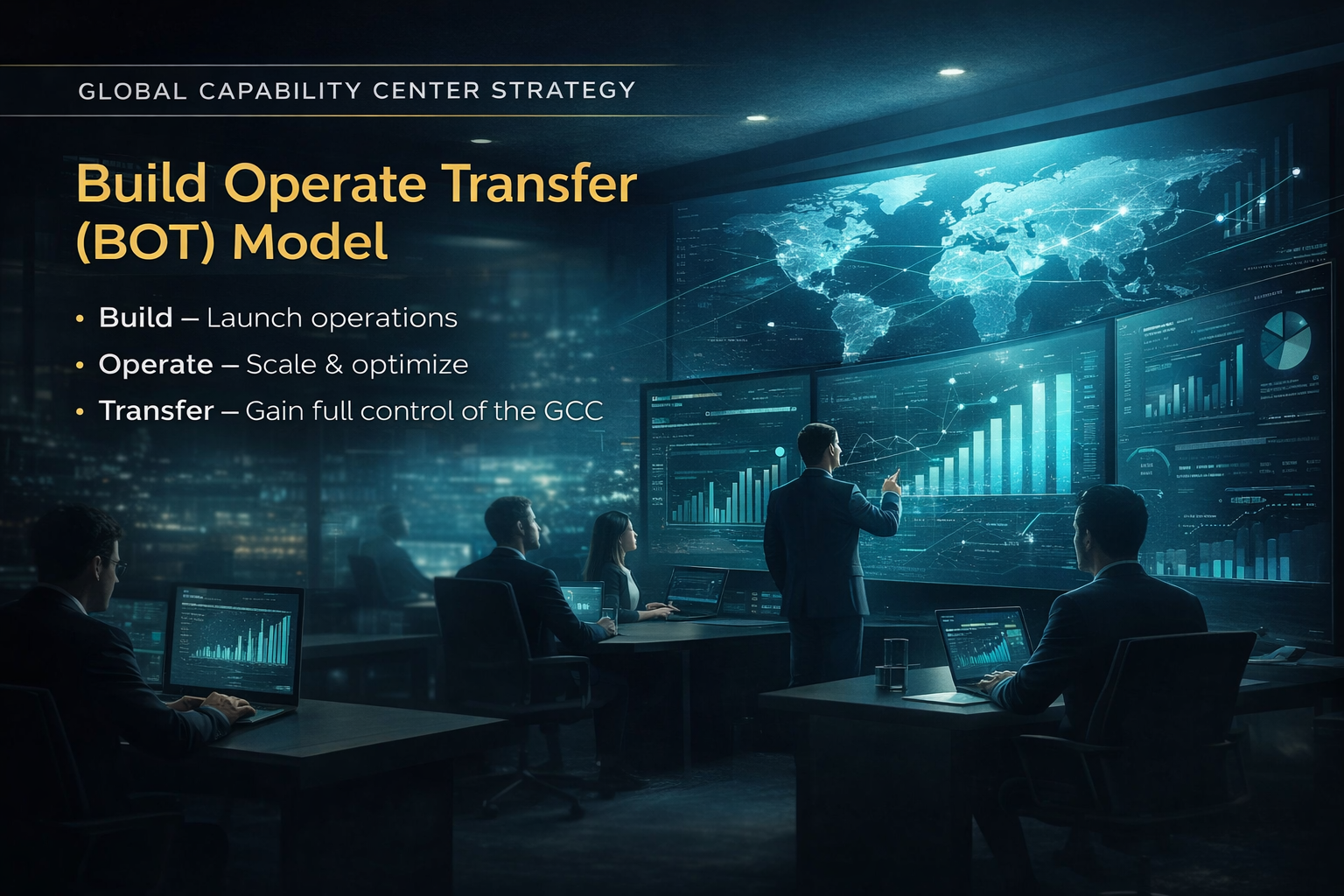
Table of Contents
Introduction
Build Operate Transfer Model: Meaning and Strategic Overview
Definition and Core Concept of the BOT Model
Historical Evolution of BOT Delivery Models
The Structural Framework of BOT Agreements
The Three Core Phases of the BOT Model
Strategic Benefits of the Build Operate Transfer Model
Risk Allocation and Governance in BOT Projects
Applications of BOT in Infrastructure and IT Operations
Key Variations of the BOT Model
BOT Compared with Other Delivery Models
Strategic Considerations for Enterprises Implementing BOT
Future Outlook for the BOT Model
Conclusion
Introduction
The Build Operate Transfer model has emerged as one of the most strategic frameworks for enterprises seeking to expand operational capabilities across geographies without assuming the full burden of early-stage risk and capital. As global markets demand faster deployment, lower entry barriers, and structured ownership pathways, the BOT model addresses each of these priorities within a single, coherent contractual structure.
Across infrastructure development and technology expansion alike, organizations are increasingly moving away from binary choices between full outsourcing and direct investment. The BOT model offers a structured middle path: a private or specialist partner designs, builds, and operationalizes the engagement before formally transferring control to the client organization at an agreed point in the lifecycle.
Enterprises establishing global capability centers or offshore technology teams often collaborate with global capability center advisory specialists to structure BOT engagements that align with enterprise governance, regulatory requirements, and long-term operational ownership goals.
This article explains the meaning of the BOT model, how the framework works, its lifecycle stages, strategic advantages, and the implications for organizations evaluating it as a global delivery approach.
Build Operate Transfer Model: Meaning and Strategic Overview
The Build Operate Transfer model is a contractual arrangement under which a private or specialist entity takes responsibility for building and operating a facility, technology center, or service function on behalf of a client organization for a defined period, before transferring full ownership and operational control back to that client.
What distinguishes BOT from conventional outsourcing is the explicit intent of eventual ownership. The partner is not a perpetual service provider; it is a transitional builder, operator, and knowledge custodian whose mandate concludes with a structured transfer. This framing fundamentally changes the governance dynamic, the incentive structure, and the accountability model throughout the engagement.
For large enterprises, this structure accelerates project delivery while substantially reducing the financial and operational exposure inherent in direct greenfield establishment.
Definition and Core Concept of the BOT Model
At its core, the BOT model definition describes a concession-based delivery structure in which a project developer or specialist partner assumes responsibility for design, construction, and operations for a specified period, during which the partner recovers its investment, before ownership is transferred to the client or public authority.
The three structural elements that define any BOT arrangement are: a concession agreement that specifies scope, governance, and timelines; an operational period that allows the partner to stabilize performance and recover investment; and a formal transfer mechanism through which assets, teams, intellectual property, and operational responsibilities are conveyed to the client.
This structure is equally applicable to physical infrastructure projects, offshore technology functions, and global capability centers, making it one of the most versatile project delivery frameworks in use today.
Historical Evolution of BOT Delivery Models
BOT frameworks originated in large-scale public infrastructure financing, where sovereign governments lacked the capital to fund highways, power generation assets, and port facilities entirely from public budgets. The model enabled private capital to fund construction and operations in exchange for a defined concession period during which the developer recovered its investment.
Over subsequent decades, the BOT structure migrated beyond infrastructure. As multinational corporations began establishing offshore technology centers in the 1990s and 2000s, the same logic applied: a specialist partner could absorb the risk of establishment, stabilize operations, and then transfer a mature, high-performing center to the enterprise client.
Today, the model has become a foundational structure for global capability center formation, particularly in high-growth markets such as India, where regulatory complexity, talent acquisition, and operational setup require deep local expertise.
The Structural Framework of BOT Agreements
A well-governed BOT agreement incorporates several essential components that define responsibilities across the full project lifecycle. The concession agreement establishes the legal foundation, specifying the scope of work, the operational period, performance benchmarks, and the conditions governing transfer.
From a financing perspective, BOT arrangements clarify which party bears investment responsibility at each stage. In most IT and GCC-focused BOT models, the partner funds establishment costs and recoups through a service fee structure, while the client retains the right to assume ownership at a defined point. Special purpose vehicles or dedicated legal entities are often used to govern project delivery and provide cleaner asset transfer pathways at the transfer stage.
Performance monitoring clauses, intellectual property protections, and defined escalation procedures are essential governance elements that should be embedded in any well-structured BOT agreement.
The Three Core Phases of the BOT Model
Build Phase: - During the Build phase, the specialist partner assumes full responsibility for establishing the operational foundation. This includes office space procurement, IT infrastructure deployment, legal entity formation, regulatory compliance, and talent acquisition. The partner designs the organizational structure, defines roles, and recruits leadership and core teams aligned with the client's functional requirements. Critically, the Build phase is not merely a logistics exercise. It requires deep alignment with the client's technology architecture, delivery standards, and cultural imperatives, so that the center is structured for long-term performance from inception.
Operate Phase: - In the Operate phase, the partner manages day-to-day operations under agreed key performance indicators and service-level agreements. The partner oversees HR, payroll, vendor management, and facilities, while the operational teams deliver technology, analytics, research, or business process functions on behalf of the enterprise client. This phase typically spans 18 to 36 months, during which the partner focuses on performance stabilization, continuous improvement, and progressive knowledge transfer to the client's internal stakeholders.
Transfer Phase: - The Transfer phase is the defining differentiator of the BOT model. Through a structured transition plan, ownership of employment contracts, infrastructure, intellectual property, governance frameworks, and operational processes is formally conveyed to the client. Transition support is typically provided post-transfer to ensure continuity and stability.
Strategic Benefits of the Build Operate Transfer Model
The Build Operate Transfer outsourcing model delivers a clear set of strategic advantages for enterprise clients.
Reduced upfront capital exposure: The partner absorbs establishment costs, allowing the client to defer significant capital deployment until the center is proven and operational.
Access to specialized local expertise: Partners with established networks in target markets accelerate talent acquisition, regulatory navigation, and vendor management significantly faster than direct approaches.
Shared risk during critical phases: The partner carries construction, operational, and compliance risk during the build and operate stages, transferring a mature asset rather than an unproven one.
Faster market entry: BOT eliminates the need for the enterprise to develop local capabilities from scratch, compressing the timeline from decision to productive operation.
Long-term ownership with short-term flexibility: The enterprise retains the option to assume full ownership once the center meets defined performance thresholds.
Risk Allocation and Governance in BOT Projects
Effective risk allocation is central to a well-structured BOT framework. BOT agreements distribute risk across four primary categories: construction and technical risk, which sits with the partner during the build phase; financial and investment risk, managed through fee structures and milestone-based payments; operational risk, shared during the operate phase through KPIs and SLAs; and regulatory and policy risk, managed through local compliance expertise embedded in the partner's operational model.
A joint steering committee structure, with defined reporting cadences and escalation pathways, ensures that the enterprise client maintains strategic visibility throughout the engagement without assuming day-to-day management burden.
Applications of BOT in Infrastructure and IT Operations
The BOT project delivery model has proven effective across a wide range of sectors and project types.
Transportation infrastructure: highways, airports, and urban transit systems have long used BOT structures to attract private capital into public asset development.
Energy generation: independent power producers frequently operate under BOT concessions before transferring assets to public utilities or national energy companies.
Offshore software development centers: technology companies entering new delivery markets use BOT to establish and stabilize engineering teams.
Global capability centers: multinational corporations establishing GCCs in India increasingly adopt BOT frameworks to manage the complexity of setup while retaining a clear path to full ownership.
Key Variations of the BOT Model
Several derivative structures adapt the core BOT logic to different ownership and financing requirements.
Build Own Operate Transfer (BOOT): The private entity holds ownership of the asset during the operational period, generating returns through user fees or service revenues, before transferring ownership to the client or government authority at the end of the concession.
Build Own Operate (BOO): The developer retains indefinite ownership and operational control, with no transfer obligation. This structure is common in energy and telecommunications where long-term private ownership is commercially viable.
Build Lease Transfer (BLT): The developer builds the facility and leases it to the client during the operational phase, with transfer of ownership occurring at the end of the lease period. This structure reduces early operational risk for the client while maintaining a clear ownership pathway.
Strategic Considerations for Enterprises Implementing BOT
Organizations evaluating a BOT engagement should address several strategic priorities before committing to a partnership structure.
Partner selection: The BOT partner's local market depth, talent networks, regulatory expertise, and track record of successful transfer engagements are the most critical selection criteria.
Concession period design: The operational period must be sufficiently long to achieve performance maturity, but not so extended that the enterprise defers ownership unnecessarily. Eighteen to thirty-six months is a common benchmark for technology center BOT engagements.
Governance architecture: Defining performance metrics, escalation procedures, and knowledge transfer milestones at the outset prevents ambiguity at the transfer stage.
Internal readiness: The client organization must develop the internal capability to absorb and lead the center post-transfer. This requires deliberate preparation during the operate phase, not just at the point of handover.
Future Outlook for the BOT Model
The Build Operate Transfer framework is positioned for continued expansion across both infrastructure and technology sectors. As multinational corporations accelerate GCC formation strategies in high-growth markets, BOT will remain the preferred entry model for enterprises that require expertise-led establishment without sacrificing long-term ownership.
The integration of digital project management platforms, real-time governance dashboards, and AI-assisted performance monitoring into BOT operating models is making the operate phase more transparent and the transfer phase more predictable.
Regulatory environments in markets such as India are also evolving to support structured foreign enterprise establishment, creating a more favorable backdrop for BOT engagements that combine private sector expertise with enterprise ownership intent.
Conclusion
The Build Operate Transfer model represents one of the most strategically coherent frameworks available to enterprises pursuing large-scale infrastructure development or global capability center expansion. By distributing risk across a defined lifecycle, providing access to specialized local expertise, and maintaining a clear pathway to full operational ownership, BOT enables organizations to accelerate development timelines without compromising long-term control.
As global delivery models continue to evolve, BOT frameworks will remain a critical mechanism for enabling technology-led expansion at scale, particularly for enterprises entering complex markets where regulatory, talent, and infrastructure variables demand local depth.
Organizations evaluating BOT engagements for infrastructure projects or global capability center expansion often collaborate with global capability center strategy advisors to design scalable BOT frameworks aligned with long-term business objectives, governance requirements, and operational ownership goals.
About the author
- Embark offers end-to-end, practitioner-led GCC solutions for global companies in India through services covering workspace, talent, operations, strategy & more.
Comments
Join the discussionNo comments yet. Be the first to comment.